
The Agentic Platform Operating Model: Moving from Overlay to Embedded Execution
In my earlier article, “How to Choose the Right Agentic AI Operating Model,” I introduced six operating models for moving from AI experimentation to enterprise-scale value — each reflecting a different approach to AI, enterprise systems, execution authority, governance, people and processes.
Read the earlier article: How to Choose the Right Agentic AI Operating ModelI then explored the first model, the Enterprise Overlay (SaaS Overlay) — adding intelligence and orchestration across the existing digital core without immediately replacing it.
Read the Enterprise Overlay article
This article takes the framework one step further: the Agentic Platform Operating Model — where Agentic AI moves from being an overlay to becoming part of the enterprise execution architecture.
But what happens when the organization wants to go further?
What happens when the enterprise no longer wants AI merely to sit above the existing applications, but wants Agentic AI to become part of the execution architecture itself?
That is where the Agentic Platform Operating Model comes in.
From Overlay to Embedded Execution
The Enterprise Overlay is attractive because it can be deployed relatively quickly and with limited disruption.
The existing SaaS and legacy applications remain in place.
The Agentic AI layer provides intelligence and orchestration across them.
But there is an inherent limitation:
The existing platforms continue to retain primary execution authority.
The Agentic layer can coordinate.
It can reason.
It can recommend.
It can orchestrate.
But ultimately, it remains dependent on the execution capabilities and constraints of the underlying platforms.
As enterprises become more mature in their Agentic AI adoption, this can become a constraint.
The organization may begin asking:
- Why should the agent always hand execution back to the application?
- Why should decision logic remain distributed across multiple workflows?
- Why should the agent have to work around application boundaries?
- Why should the enterprise maintain a separate intelligence layer indefinitely?
- Can Agentic AI become part of the enterprise’s core execution architecture?
This is the transition from overlay to embedded execution.
The Agentic Platform Operating Model addresses precisely this requirement.
The framework describes it as an Embedded Agentic Platform Operating Model, where Agentic AI execution becomes part of the core enterprise stack or is co-architected with the enterprise platforms.
What Is the Agentic Platform Operating Model?
The Agentic Platform Operating Model integrates Agentic AI more deeply into the enterprise technology landscape.
Instead of placing the Agentic layer simply above existing applications, the Agentic components become embedded within applications or integrated directly with the enterprise digital core.
This means Agentic AI begins participating in the core execution logic.
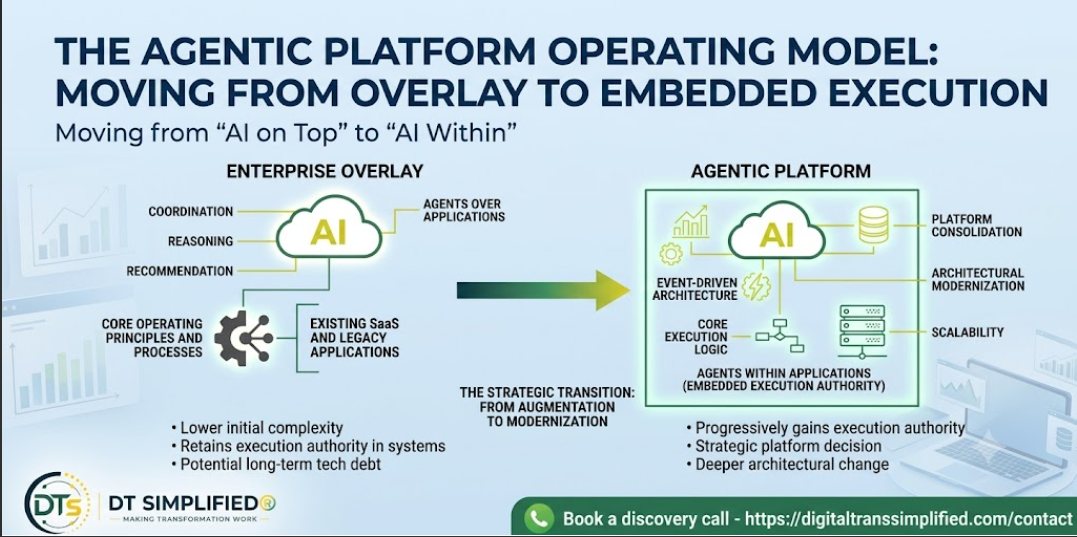
The distinction between the first two models can therefore be summarized simply:
Enterprise Overlay
Existing applications → retain execution authority
Agentic Platform
Agentic layer → progressively gains execution authority
This is a significant architectural and operating-model shift.
The framework describes the model as particularly relevant when organizations are pursuing:
- Long-term sustainability
- Deeper architectural modernization
- Platform modernization
- Digital transformation
- Platform consolidation
Rather than superimposing Agentic AI as another layer, the enterprise can begin selecting or evolving platforms in which Agentic AI capabilities are embedded directly into the architecture.
Why Would an Enterprise Move Beyond the Overlay?
The Overlay solves one problem:
How do we introduce Agentic AI without disrupting our existing systems?
The Agentic Platform solves a different problem:
How do we make Agentic AI a fundamental part of how enterprise execution happens?
This distinction becomes increasingly important as the number of agents and AI-enabled workflows grows.
An overlay can initially simplify adoption.
But over time, maintaining intelligence and orchestration outside the core platforms can introduce:
- Additional integration complexity
- Duplication of logic
- Technical debt
- Dependency on APIs and connectors
- Fragmented execution authority
The framework explicitly identifies this as a limitation of the Overlay model: although it is quickly deployable, it can introduce long-term complexity and technical debt when enterprises are looking for deeper architectural modernization.
The Agentic Platform therefore represents a shift from:
AI as an additional intelligence layer
to:
AI as part of the execution architecture.
The Most Important Shift: Execution Authority
This is perhaps the most important distinction between the two models.
In the Enterprise Overlay:
The SaaS platform remains the primary execution engine.
The Agentic layer coordinates or influences the execution.
In the Agentic Platform:
Partial execution authority moves into the Agentic layer.
Decision logic progressively shifts toward the agentic architecture.
This does not mean that every decision suddenly becomes autonomous.
Rather, execution authority can be delegated within defined boundaries.
That distinction matters because Agentic AI is ultimately about more than intelligence. It is about delegated decision-making and execution authority.
The framework defines execution authority as the roles empowered to decide and act within the Agentic AI framework.
The enterprise must determine which decisions can be made autonomously, within what boundaries, and when authority must revert to human intervention.
What Does “Embedded” Actually Mean?
Embedded does not necessarily mean that one AI component is physically buried inside one application.
The framework identifies several ways in which Agentic components can become integrated with the enterprise core:
- Native platform extensions
- Shared data models
- Event-driven architecture
- Domain-level service orchestration
The defining characteristic is where the Agentic capability resides in relation to execution.
The deeper the integration, the more the Agentic layer can participate directly in enterprise execution.
This creates three sub-operating models.
Three Agentic Platform Sub-Operating Models
1. Domain-Embedded Model
In the Domain-Embedded Model, Agentic logic is embedded within specific functional platforms.
Examples could include:
- Supply chain
- Finance
- Customer operations
The execution authority lies within that domain.
This creates a more focused form of Agentic transformation.
The enterprise does not necessarily attempt to create one universal Agentic Platform immediately.
Instead, individual domains progressively embed Agentic capabilities into the platforms that support their operations.
This model is particularly relevant where the business domain has:
- Distinct processes
- Clear ownership
- Specific decision logic
- Defined execution boundaries
The key difference from the Enterprise Overlay is that the Agentic capability is no longer merely coordinating the domain from outside.
It becomes part of the domain’s execution architecture.
2. Core-Integrated Model
The Core-Integrated Model takes the concept further.
Agentic reasoning becomes part of the enterprise digital core.
It can therefore support broader domain orchestration and execution authority.
The Agentic capability becomes connected with:
- Shared data layers
- Identity systems
- Transaction platforms
- Enterprise-level services
This is a much more significant architectural transformation.
Instead of having multiple independent domain-level Agentic implementations, the enterprise begins creating an Agentic capability that can operate across the digital core.
The ambition changes from:
“Make this domain intelligent.”
to:
“Make the enterprise digital core capable of intelligent execution.”
This is why the Core-Integrated Model is more closely associated with long-term platform modernization and enterprise transformation.
3. Progressive Migration Model
The third variant recognizes an important reality:
Enterprises rarely transform their execution architecture overnight.
The Progressive Migration Model therefore begins with Agentic capabilities embedded in selected domains and gradually migrates workflow logic from deterministic systems into the Agentic Platform over time.
This creates a path from:
Deterministic workflow
→ Embedded Agentic capability
→ Progressive transfer of execution authority
→ Agentic execution
It provides a way to evolve the enterprise architecture without requiring an immediate wholesale transformation.
This is particularly important for large enterprises where existing systems cannot simply be switched off and replaced.
The organization can progressively determine which workflows, decisions and execution responsibilities are suitable for migration.
The IT Operating Model Matters Even More Here
The deeper the Agentic Platform becomes embedded in enterprise execution, the more important the IT operating model becomes.
The Agentic Platform Operating Model aligns most strongly with:
Centralized IT
The Agentic Platform becomes part of the enterprise digital core.
It is typically owned, governed and evolved by functions such as:
- Enterprise Architecture
- Platform Engineering
- Digital Transformation Office
This provides the architectural discipline required for a shared execution platform.
IT Shared Services
The Agentic Platform can operate as a core digital platform service, consumed by business units through standardized processes.
This can provide economies of scale while retaining enterprise governance.
Federated IT
The model can work in a Federated IT environment, but only when strong architectural standards are enforced.
Without those standards, different domains may begin embedding different execution logic, creating fragmentation and potentially increasing technical debt.
Decentralized / Shadow IT
This model is generally unsuitable for highly decentralized or shadow IT environments.
The reason is straightforward:
Embedded execution authority requires architectural discipline and coordinated platform strategy.
Build, Buy or Rent?
As with the Enterprise Overlay, the Agentic Platform Operating Model also raises the question:
Should the enterprise Build, Buy or Rent its Agentic capability?
The framework identifies all three strategies.
However, the strategic considerations are different because the Agentic Platform is becoming part of the enterprise execution architecture.
Build
In the Build approach, the organization develops the embedded Agentic Platform and owns the full lifecycle of:
- Architecture
- Agentic components
- Implementation
- Data integration
- Platform evolution
- Governance
Cloud architecture becomes strategically important because the platform needs scalability, resilience and modular integration.
A cloud-native architecture can support:
- Microservices
- Modular integration
- Event-driven orchestration
- Elastic scalability
Private or hybrid deployments may be relevant where regulatory or data-sovereignty considerations are important.
The trade-off is higher upfront investment and the need for sustained platform engineering capability.
The Build strategy is therefore particularly suited to organizations that want to progressively shift primary execution authority into the Agentic Platform.
The framework identifies the strongest fit with Centralized IT and the Core-Integrated Model.
Buy
The framework also identifies Buy as an implementation strategy for the Agentic Platform.
In this model, the enterprise adopts a commercial Agentic Platform and integrates it into the enterprise architecture.
The exact economics, deployment model and governance implications would depend on the platform selected and the enterprise’s technology and regulatory context.
The important distinction from the Overlay Buy strategy is that the purchased capability is being considered as a core component of the enterprise execution architecture, rather than simply as an intelligence layer above existing applications.
Rent
The framework also identifies Rent as an implementation strategy.
Here, the enterprise consumes Agentic capabilities as a service rather than owning the underlying platform architecture.
For an Agentic Platform model, however, this requires careful consideration because the platform is becoming increasingly important to enterprise execution authority.
The question therefore becomes not simply:
“Can we consume this capability as a service?”
but:
“How much execution authority are we prepared to delegate to a platform that we do not fully own?”
That is an operating-model decision, not simply a sourcing decision.
The Architectural Trade-Off
The movement from Overlay to Agentic Platform therefore creates a fundamental trade-off.
Enterprise Overlay
Lower disruption
Faster adoption
Existing systems retained
Existing execution authority retained
Lower architectural commitment
But:
Greater dependency on existing platform constraints
Integration complexity
Potential long-term technical debt
Agentic Platform
Deeper architectural integration
Greater execution authority
More coherent enterprise orchestration
Potentially stronger long-term sustainability
But:
Higher transformation effort
Greater architectural commitment
Greater governance requirements
More significant organizational change
The choice therefore depends on the enterprise’s transformation ambition.
When Does the Agentic Platform Model Make Sense?
The Agentic Platform becomes particularly relevant when an enterprise:
- Is pursuing significant platform modernization
- Is consolidating enterprise platforms
- Wants Agentic AI to become part of its digital core
- Needs deeper cross-domain orchestration
- Wants execution authority to progressively shift toward the Agentic layer
- Has strong architectural governance
- Has the organizational capability to manage an enterprise Agentic Platform
- Is thinking beyond individual AI use cases and toward enterprise-scale autonomy
It may be premature when:
- The enterprise is still experimenting with AI
- Existing systems are not sufficiently integrated
- Governance maturity is low
- Business units operate independently without architectural discipline
- The organization is not ready to delegate execution authority
- The primary objective is simply to augment existing workflows quickly
In those situations, the Enterprise Overlay may be the more pragmatic starting point.
From “AI on Top” to “AI Within”
This is ultimately the conceptual shift between the first two operating models.
Enterprise Overlay
AI on top of the enterprise
Agentic Platform
AI within the enterprise execution architecture
The difference may look subtle from the outside.
But it is fundamental.
In the first model, AI works around existing execution structures.
In the second, the execution structure itself begins to evolve around Agentic AI.
That is why the Agentic Platform is not simply a more advanced version of the SaaS Overlay.
It represents a different level of architectural and operating-model commitment.
The Progressive Shift in Enterprise Role Design
There is also a human and organizational implication.
As execution authority moves into the Agentic Platform, human roles begin to change.
Traditional enterprise systems rely heavily on people to:
- Interpret information
- Make operational decisions
- Initiate workflows
- Approve actions
- Resolve exceptions
- Coordinate across systems
In a more agentic enterprise, humans increasingly define:
Intent + Constraints + Boundaries
while the Agentic Platform increasingly determines:
Operational sequencing + Decision execution + Routine exception resolution
The framework describes this as a redistribution of responsibility:
Strategic definition moves upward into governance and leadership.
Operational control moves downward into the platform.
This has implications for:
- Organizational structure
- Skills
- Accountability
- Performance management
- Governance
So again, the Agentic Platform is not merely a technology architecture.
It is an operating-model decision.
The Relationship Between the First Two Models
The most useful way to understand these two models may therefore be as a continuum.
Enterprise Overlay
Preserve → Augment → Coordinate
The enterprise keeps its existing systems and adds intelligence across them.
↓
Agentic Platform
Embed → Integrate → Delegate
The enterprise progressively embeds Agentic AI into the execution architecture and delegates more authority to it.
The first model prioritizes pragmatism and minimal disruption.
The second prioritizes architectural modernization and deeper autonomy.
Neither is universally better.
The question is:
Where is your enterprise today — and how much architectural change is it prepared to undertake?
Where Does the Agentic Platform Fit in the Six-Model Framework?
The broader DT Simplified® framework positions the six operating models as different ways of operationalizing Agentic AI:
| Operating Model | Core Idea |
|---|---|
| Enterprise Overlay | Add intelligence and orchestration above existing systems |
| Agentic Platform | Integrate Agentic AI into the enterprise execution architecture |
| SaaS-Native Agentic Reengineering | Redesign workflows around embedded AI capabilities |
| Federated Domain | Enable domain-level autonomy within enterprise governance |
| Marketplace-Driven | Standardize, reuse and scale AI capabilities across departments |
| Hybrid Transitional | Allow different operating models to coexist as the enterprise evolves |
The models are not necessarily sequential.
An enterprise may use different models across different parts of its landscape.
But they provide a useful way to think about the degree of architectural integration, autonomy, governance and organizational change required.
Final Thought
The Enterprise Overlay asks:
How can we add intelligence to what we already have?
The Agentic Platform asks a more fundamental question:
What if Agentic AI became part of how the enterprise executes?
That is the real shift.
Moving from overlay to embedded execution is not simply about deploying more capable agents.
It is about deciding where execution authority should reside.
And once that authority begins moving into the Agentic Platform, the enterprise is no longer just adopting AI.
It is redesigning its operating model around AI.
That is why the Agentic Platform Operating Model is particularly relevant for organizations pursuing platform modernization, digital transformation and platform consolidation.
The question is no longer:
“Can we make our applications intelligent?”
It becomes:
“How much of enterprise execution are we prepared to make agentic?”
And that answer should determine not only the technology architecture — but the operating model that surrounds it.