Every week, I speak with executives who are eager to deploy AI agents. Their questions often revolve around technology:
Which LLM should we use? Should we build with open-source frameworks or buy a commercial platform? How many agents do we need?
These are valid questions, but they are rarely the first ones organizations should ask.
The more fundamental question is:
What operating model is best suited to our enterprise?
An operating model defines how AI agents are governed, how they interact with enterprise systems, where decisions are made, and how responsibilities are shared between humans, business functions, and intelligent agents. Choosing the wrong operating model can lead to fragmented automation, duplicated effort, governance challenges, and AI initiatives that never move beyond isolated pilots.
There is no universally “best” operating model. The right choice depends on your existing technology landscape, organizational structure, process maturity, and long-term transformation goals.
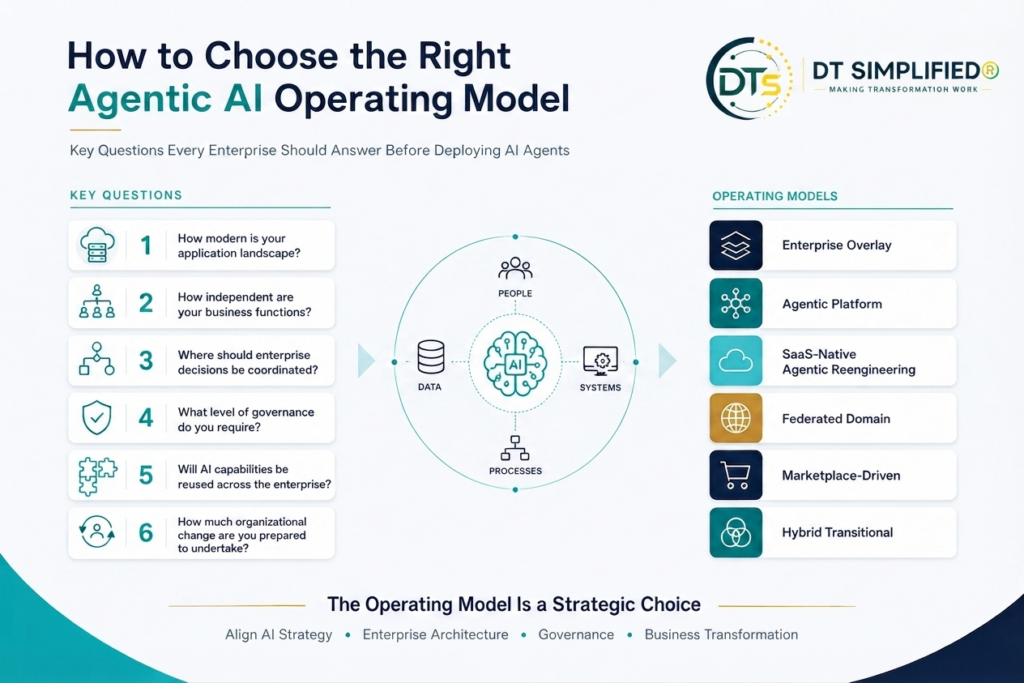
Before deciding how to deploy Agentic AI, consider the following questions.
- How modern is your application landscape?
The first consideration is the technology foundation on which your business operates.
Organizations running a large number of legacy applications often face significant integration challenges. Replacing these systems is expensive, disruptive, and rarely feasible as a first step. In such environments, AI agents can provide value by orchestrating work across existing systems without requiring immediate replacement.
Conversely, organizations that have already standardized on modern cloud-based SaaS platforms may benefit from redesigning processes around the intelligent capabilities embedded within those platforms rather than introducing another orchestration layer.
The maturity of your application landscape often determines whether AI should complement existing systems or become the primary way work is coordinated.
- How independent are your business functions?
Enterprise structures vary considerably.
Some organizations operate with highly centralized functions where processes, governance, and technology decisions are coordinated across the enterprise. Others provide significant autonomy to business units, regions, or departments.
When business domains have distinct processes, regulatory obligations, or operational priorities, they may require specialized AI agents designed for their unique needs. However, this autonomy should still be balanced with enterprise standards for security, governance, and interoperability.
The more decentralized the organization, the more important it becomes to distinguish between local flexibility and enterprise consistency.
- Where should enterprise decisions be coordinated?
Many organizations begin by deploying AI agents within individual functions. Over time, however, the challenge shifts from creating agents to coordinating them.
Should business processes continue to be initiated by traditional enterprise applications? Or should intelligent agents orchestrate work across multiple systems, invoking applications only when necessary?
This decision fundamentally changes the role of enterprise software.
In some organizations, ERP, CRM, and HR platforms remain the primary execution engines with AI acting as an intelligent assistant. In others, the Agentic AI platform evolves into the coordination layer that directs enterprise workflows while transactional systems provide data and record business events.
Neither approach is inherently superior. The appropriate choice depends on governance maturity, operational complexity, and organizational readiness.
- What level of governance do you require?
As AI agents become more capable, governance becomes increasingly important.
Organizations operating in highly regulated industries may require strict approval workflows, audit trails, explainability, and clearly defined decision boundaries. Others may prioritize speed, experimentation, and innovation.
An operating model should reflect the organization’s governance expectations rather than simply maximizing automation.
The question is not how much autonomy AI can achieve, but how much autonomy the organization is prepared to manage responsibly.
- Will AI capabilities be reused across the enterprise?
Many organizations unknowingly build the same capability multiple times.
One department develops a contract review agent. Another creates a similar agent for procurement. A third develops a slightly different version for compliance. Over time, maintaining these independent solutions becomes increasingly difficult.
Organizations that anticipate broad adoption of Agentic AI should consider whether AI capabilities will become shared enterprise assets. Reusable agents, standardized services, and common governance practices can significantly reduce duplication while accelerating innovation.
Thinking beyond individual projects helps establish a foundation for long-term scalability.
- How much organizational change are you prepared to undertake?
Not every organization is ready for enterprise-wide transformation.
Some prefer incremental improvements that preserve existing operating models and minimize disruption. Others are prepared to redesign processes, redefine responsibilities, and rethink how work is performed across the enterprise.
The chosen operating model should align with the organization’s capacity for change—not just its technological ambition.
Successful transformation is rarely determined by the sophistication of AI. It is determined by the organization’s ability to adapt its people, processes, governance, and culture alongside technology.
Matching the Operating Model to Your Enterprise
There is no decision tree that guarantees the right answer, but certain organizational characteristics naturally align with different operating models.
- Organizations with significant legacy investments often benefit from an Enterprise Overlay approach that augments existing systems while preserving systems of record.
- Enterprises that want AI to coordinate business execution across applications may be better suited to an Agentic Platform model where intelligent agents become the operational orchestration layer.
- Organizations that have embraced modern SaaS ecosystems may find greater value in a SaaS-Native Agentic Reengineering approach that redesigns workflows around embedded AI capabilities.
- Businesses with highly autonomous functions often require a Federated Domain model that combines local innovation with enterprise governance.
- Enterprises seeking to standardize and scale AI capabilities across departments should consider a Marketplace-Driven approach that promotes reuse, composability, and shared services.
- Most organizations, however, will find themselves operating in a Hybrid Transitional model where different parts of the business adopt different approaches based on their maturity, risk profile, and strategic priorities.
These operating models should not be viewed as competing alternatives. They are architectural patterns that can coexist within the same enterprise, evolving as business needs change.
Read more about the six operating models here:
🔗 LinkedIn Article:
https://www.linkedin.com/feed/update/urn:li:activity:7483728791446388737/
The Operating Model Is a Strategic Choice
The conversation around Agentic AI often focuses on the intelligence of individual agents. In practice, the greater challenge is determining how those agents fit into the enterprise.
Technology decisions can often be revised. Operating model decisions shape governance, accountability, organizational design, and the pace of transformation. They influence how AI scales, how risks are managed, and how business value is sustained over time.
Before asking “How do we build more AI agents?”, leaders should first ask a more important question:
“What operating model will allow those agents to create value at enterprise scale?”
The answer to that question is likely to have a greater impact on long-term success than the choice of any individual AI platform or model.
At DT Simplified®, we help organizations simplify digital transformation by aligning strategy, enterprise architecture, governance, and AI-enabled innovation to deliver sustainable business outcomes.
🌐 Website: https://digitaltranssimplified.com/
Want more perspectives on digital transformation, data and AI?
Explore all insights →