In my earlier blog, “How to Choose the Right Agentic AI Operating Model,” I explored a question that is becoming increasingly important as enterprises move beyond AI experimentation:
The question is no longer simply which AI agent platform to buy. It is which operating model will allow AI agents to create value at enterprise scale.
Read the earlier article: How to Choose the Right Agentic AI Operating Model
The reason this question matters is simple.
Enterprises do not begin their Agentic AI journey with a blank sheet. They already have ERP, CRM, HRMS, ITSM, project management, data platforms, document repositories and industry-specific applications. Many of these systems are deeply embedded, heavily customized and business critical.
Replacing them simply to introduce Agentic AI is rarely practical.
This is why the Enterprise Overlay Agentic Operating Model, which I refer to more simply as the SaaS Overlay, is often the most pragmatic starting point.
It is the first of six operating models in the DT Simplified® Agentic AI Operating Model framework:
Enterprise Overlay
Agentic Platform
SaaS-Native Agentic Reengineering
Federated Domain
Marketplace-Driven
Hybrid Transitional
These should not be viewed as competing alternatives. They represent different ways in which Agentic AI can be operationalized depending on the enterprise’s technology landscape, organizational structure, governance requirements, process maturity and transformation ambition.
This article takes a deeper look at the first model.
What is the Enterprise Overlay Agentic Operating Model?
Most enterprises cannot afford a clean architectural restart every time they need to innovate.
Large organizations may already have years of IT investments, long application contracts and a web of enterprise SaaS applications that are deeply embedded in business operations.
Replacing these systems upfront may not be practical or possible.
If the organization wants to introduce intelligent orchestration between different systems and domains without disrupting these existing implementations, the Enterprise Overlay Agentic Operating Model becomes a pragmatic option.
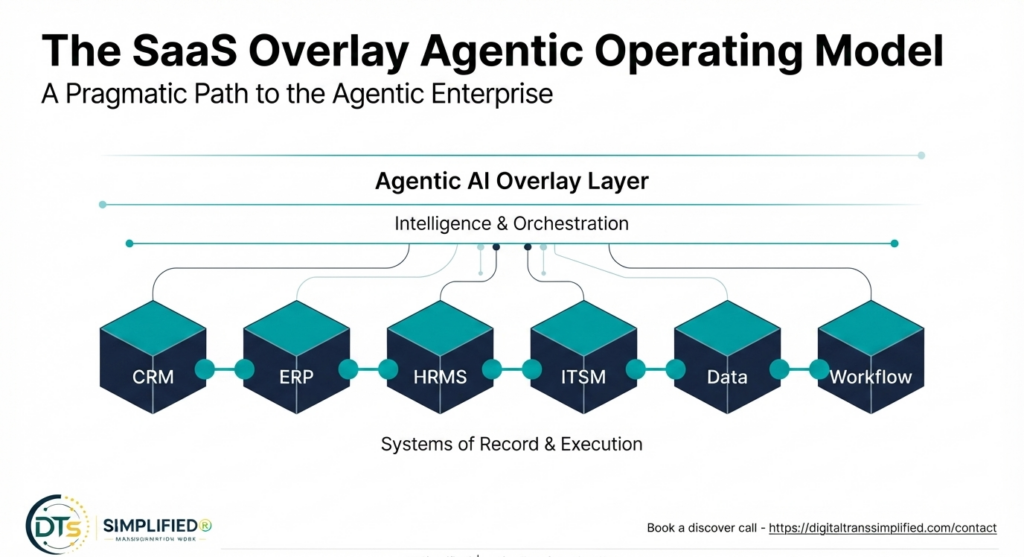
In this model, the Agentic AI framework is implemented as an overlay on top of existing SaaS platforms, legacy applications and workflow engines.
The Agentic AI layer acts as a:
Coordination layer + Intelligence layer
while the existing enterprise platforms continue to operate.
The SaaS platforms retain their execution authority.
Systems of record remain in place.
Native workflows are retained.
The Agentic AI layer provides intelligence and orchestration across them.
This makes the model particularly relevant for organizations with deeply embedded best-of-breed platforms such as Salesforce, SAP, Oracle, ServiceNow and similar enterprise applications.
Why an Overlay?
The attraction of the model is straightforward:
Introduce intelligence without immediately disrupting the digital core.
Consider an enterprise with:
CRM managing customer information
ERP managing transactions
HRMS managing employee information
ITSM managing service requests
Project systems managing delivery
Data platforms supporting analytics
Workflow engines managing process execution
Each application may work effectively within its own boundaries.
The challenge appears when the business process crosses those boundaries.
A customer-related process, for example, may require information from CRM, ERP, customer service, contracts and document repositories.
A procurement decision may require information from procurement, ERP, supplier management, contracts and finance.
A project decision may require information from schedules, costs, documents, contracts and risk systems.
The SaaS Overlay introduces an intelligent coordination layer across these systems.
The objective is not to make every underlying application autonomous.
The objective is to coordinate intelligence across the existing application landscape.
But the Overlay Has a Fundamental Constraint
The Enterprise Overlay is not the same as a fully autonomous Agentic AI platform.
The underlying SaaS and legacy systems continue to retain execution authority.
Consequently, the overlay remains constrained by:
Platform APIs
SaaS execution capabilities
Existing workflows
Integration mechanisms
System boundaries
This distinction is important.
The Agentic AI layer can make decisions, coordinate activities and orchestrate processes, but the actual execution remains dependent on what the underlying platforms permit.
In simple terms:
The overlay adds intelligence across the enterprise, but the existing platforms still control execution.
This makes the model particularly relevant for early-stage or budget-constrained Agentic AI adoption.
Three Variants of the SaaS Overlay
The Enterprise Overlay can itself be implemented at different levels of involvement.
The framework identifies three sub-operating variants.
1. Light Overlay
The Agentic AI layer is primarily used for decision-making.
The existing platform’s native workflow continues to execute the decision.
The agent therefore determines:
What should happen?
while the existing system determines:
How should it be executed?
This is the lightest form of Agentic augmentation.
2. Coordination Overlay
Here, the Agentic AI layer takes responsibility for cross-platform orchestration.
The native workflows remain responsible for logic within their respective platforms.
The Agentic layer coordinates the activities between them.
For example:
CRM → ERP → Contract System → Finance → Customer Communication
The individual systems continue to execute their own functions, while the Agentic layer coordinates the end-to-end business outcome.
This is where the overlay becomes particularly valuable for cross-system processes.
3. Intelligent Agentic Exception Handler
In this variant, the native platform continues to execute the standard workflow.
The Agentic layer intervenes primarily when something non-standard happens.
Instead of redesigning every exception path into a deterministic workflow, the agentic layer can handle selected exceptions while the normal workflow remains unchanged.
This can be a particularly pragmatic approach where the organization wants to introduce intelligence without modifying stable production workflows.
Alignment with the IT Operating Model
The Enterprise Overlay does not operate independently of the organization’s IT model.
It can align with several configurations.
Centralized IT
The Agentic Layer can be owned by the Enterprise Architecture function or AI Centre of Excellence, with IT maintaining governance of the additional layer.
IT Shared Services
Agentic AI capabilities can be provided as an internal platform service, with business units consuming orchestrated Agentic AI capabilities.
Federated IT
The overlay can be deployed centrally while being configured locally within individual business units.
This allows enterprise-level governance while retaining business-unit flexibility.
However, the model is less suitable for highly decentralized shadow IT environments, particularly where SaaS autonomy dominates IT governance.
Build, Buy or Rent?
Once the organization chooses the overlay model, another strategic decision emerges:
Should the Agentic Layer be built, bought or consumed as a service?
The framework identifies three implementation strategies.
Build
The organization develops its own Agentic AI layer and manages its architecture, governance and integrations.
This provides maximum architectural control and can support:
Deep customization
Long-term cost efficiency at scale
Reuse across business units
Greater control over the evolution of the Agentic Layer
The ability to progressively shift execution authority toward the agentic layer
The trade-off is significant upfront investment and the need for sustained platform engineering and governance capability.
The Build approach is particularly aligned with Centralized IT and the Coordination Overlay sub-model.
Buy
The organization integrates a commercial Agentic AI platform with its existing applications.
The platform provider manages the core platform capabilities, while the enterprise manages governance, customization and integration.
Depending on the organization’s requirements, the platform may be:
Vendor-hosted SaaS
Customer-hosted cloud / BYOC
Hybrid
The Buy approach is suited to organizations seeking faster deployment and lower internal development overhead while retaining reasonable scalability and control.
It aligns particularly well with Centralized IT and IT Shared Services, and with the Light Overlay and Coordination Overlay variants.
Rent
In the Rent model, the enterprise consumes Agentic AI capabilities as a service.
These may include:
Pre-built agents
Orchestrated services
Managed Agentic AI capabilities
Marketplace-based services
The service provider owns and manages the underlying architecture, infrastructure, scaling and platform enhancements.
The organization primarily configures the services and connects them to its existing applications.
This provides rapid onboarding and low upfront investment.
The trade-off is lower control over infrastructure economics and greater dependence on the service provider.
The Rent approach is particularly suited to experimentation, low entry barriers and limited upfront investment, with stronger alignment to decentralized or federated IT environments and the Light Overlay variant.
The Strategic Trade-off
The Enterprise Overlay therefore presents a very specific trade-off.
What it gives you
Speed
Lower disruption
Reuse of existing investments
Incremental adoption
Cross-system intelligence
Lower initial transformation risk
What it does not give you
Complete execution autonomy
Freedom from existing platform constraints
Freedom from integration complexity
A clean architectural reset
The model is pragmatic precisely because it works with what the enterprise already has.
But that is also its limitation.
An overlay can coordinate what exists.
It cannot eliminate the constraints of what exists.
When Does the SaaS Overlay Make Sense?
The Enterprise Overlay is particularly relevant when:
Existing SaaS investments are significant.
Core systems are deeply embedded.
Replacing systems is not economically or operationally practical.
The enterprise wants to introduce AI-driven orchestration.
The organization is at an early stage of Agentic AI adoption.
Budget constraints favour incremental adoption.
Business processes span multiple applications.
The organization wants to experiment before committing to deeper architectural change.
It becomes less attractive when the organization requires levels of autonomy that cannot be achieved through the existing platform APIs and execution capabilities.
The Overlay Is Not Necessarily the Destination
This is an important point in the broader operating-model framework.
The Enterprise Overlay may be the right starting model without being the final model.
An organization may begin with an overlay because it wants to introduce Agentic AI without disrupting its existing digital core.
As maturity increases, however, it may decide that deeper integration is required.
This creates a potential evolution toward the Agentic Platform model.
The distinction is significant.
In the Enterprise Overlay:
Existing SaaS platforms retain primary execution authority.
In the Agentic Platform:
Execution authority progressively shifts into the agentic layer.
The second model therefore represents a deeper architectural transformation. It becomes relevant when enterprises are pursuing long-term sustainability, platform modernization, digital transformation or platform consolidation.
The overlay can therefore act as both an operating model and a transition point.
The Question Is Not “Where Can We Add an Agent?”
This is where the operating-model perspective becomes important.
The objective of the SaaS Overlay should not be to create another collection of disconnected agents.
The objective is to determine:
Where can an intelligence and coordination layer create measurable business value across the systems we already have?
This is consistent with the broader Agentic AI architecture in the framework.
Agentic AI is not simply a collection of AI Agents.
It requires capabilities such as:
Goal and intent management
Advanced reasoning and planning
Multi-agent orchestration
Persistent memory
Controlled execution authority
Governance
Policy
Audit
Safety
These capabilities determine whether intelligence can move from isolated task automation toward coordinated enterprise autonomy.
Where Does the Enterprise Overlay Fit in the Six-Model Framework?
The six models represent different ways of operationalizing Agentic AI:
| Operating Model | Core Idea |
|---|---|
| Enterprise Overlay | Add intelligence and orchestration above existing systems |
| Agentic Platform | Establish an integrated agentic execution layer |
| SaaS-Native Agentic Reengineering | Redesign workflows around embedded AI capabilities |
| Federated Domain | Enable domain-level autonomy within enterprise governance |
| Marketplace-Driven | Standardize, reuse and scale AI capabilities across departments |
| Hybrid Transitional | Allow different operating models to coexist as the enterprise evolves |
The important point is that these are not six technologies to buy.
They are six ways of organizing the relationship between:
AI + enterprise systems + execution authority + governance + people + business processes.
And that relationship will determine how Agentic AI scales.
Final Thought
The SaaS Overlay is attractive because it does not ask an enterprise to abandon everything it has already built.
It asks a different question:
What if intelligence could be added across the existing enterprise without immediately replacing the digital core?
For organizations with deeply embedded SaaS and legacy investments, this can be a pragmatic entry point into Agentic AI.
But the organization must also recognize its boundary.
An overlay can coordinate what exists.
It cannot eliminate the constraints of what exists.
That is why the Enterprise Overlay Agentic Operating Model should be considered within the context of the broader six-model framework — and not treated as a universal answer.
The strategic question remains:
What operating model will allow your enterprise to move from isolated AI agents to coordinated, governed and economically sustainable autonomy?
That is the question the DT Simplified® Agentic AI Operating Model framework is designed to help answer.
Want more perspectives on digital transformation, data and AI?
Explore all insights →