In my earlier article, “How to Choose the Right Agentic AI Operating Model,” I introduced six Agentic AI operating models for enterprises moving from AI experimentation toward scaled execution.
These six models represent different ways of organizing the relationship between AI, enterprise systems, execution authority, governance, people and business processes.
The first two models establish an important progression.
The Enterprise Overlay Agentic Operating Model introduces intelligence and orchestration across the existing enterprise landscape, without replacing the underlying systems.
The Embedded Agentic Platform Operating Model takes the next step. Agentic AI becomes part of the core execution architecture, with execution authority progressively shifting toward the agentic layer.
But there is another possibility.
What happens when the enterprise is prepared not merely to add intelligence to existing processes, but to redesign those processes around modern SaaS and embedded AI?
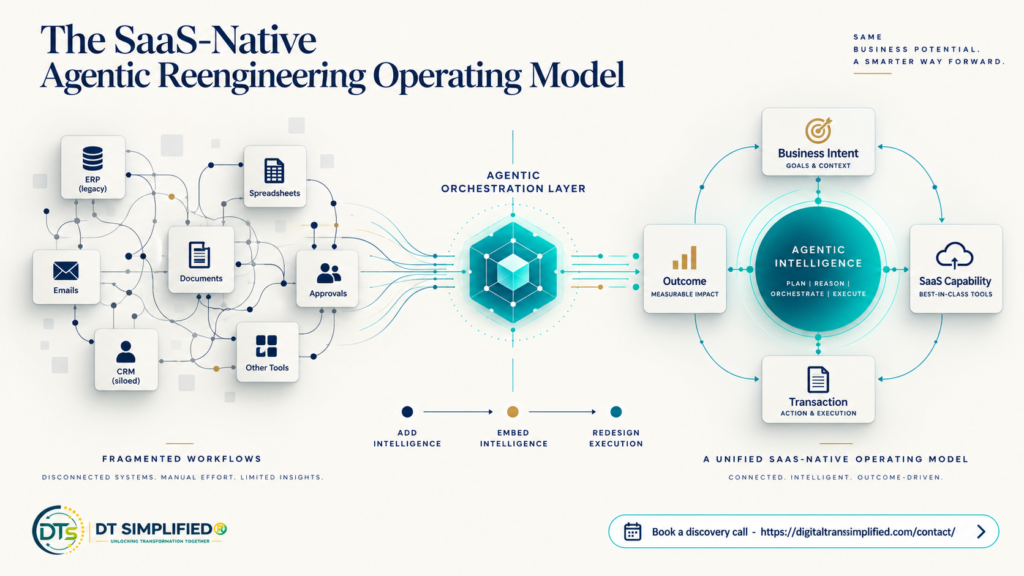
This is the SaaS-Native Agentic Reengineering Operating Model.
From Overlay to Embedded to Reengineered
The difference between these three models is not simply where the AI resides.
It is how much of the existing enterprise architecture and process design the organization is prepared to change.
With an Enterprise Overlay, the existing SaaS platforms and legacy applications remain largely intact. The Agentic AI layer sits above them, providing intelligence, decision-making and orchestration, while the existing platforms retain execution authority.
With an Embedded Agentic Platform, agentic components become part of selected enterprise platforms and participate directly in execution. The decision logic and execution authority begin to shift into the agentic layer.
With SaaS-Native Agentic Reengineering, the starting point changes.
Rather than asking how to place an agent into an existing workflow, the organization can reconsider how the workflow itself should operate when modern SaaS capabilities and embedded Agentic AI are available.
This is therefore not simply another AI implementation.
It is a business-process and operating-model transformation.
Why reengineering becomes necessary
Enterprise processes have rarely been designed from scratch as a single coherent flow.
Over time, they have accumulated applications, integrations, approvals, handoffs and workarounds.
A typical business process may span:
SaaS application → spreadsheet → email → approval → another application → manual reconciliation → exception handling
Each individual system may work perfectly well.
The difficulty emerges at the boundaries between them.
The framework identifies fragmented processes across legacy applications, teams and data sources as a major constraint on autonomous operations. Existing systems were largely designed for predictable, static workflows, while Agentic AI is intended to support dynamic decision-making and execution.
An Overlay can connect these pieces.
An Embedded Agentic Platform can progressively take over parts of their execution.
But sometimes the better answer is to ask:
Should this collection of steps exist in its current form at all?
That is the point at which reengineering becomes relevant.
Designing around the outcome rather than the workflow
Traditional automation generally starts with the existing workflow.
The organization maps the steps, identifies repetitive activities and automates them.
Agentic AI creates the possibility of starting somewhere else:
What outcome are we trying to achieve?
The process can then be redesigned around:
Intent → Reasoning → Action → Exception → Outcome
rather than reproducing every existing human handoff.
For example, consider procurement.
A conventional process may involve:
Requisition → Approval → Supplier search → RFQ → Evaluation → Negotiation → Purchase Order
An Overlay can coordinate these activities across the existing systems.
An Embedded Agentic Platform can bring agentic capabilities into the procurement platform and allow the agentic layer to execute selected parts of the process.
A SaaS-Native Agentic Reengineering approach can go further.
The process could be redesigned around the procurement objective, with Agentic AI handling appropriate sourcing, evaluation and coordination activities within defined policies and authority boundaries.
Humans remain involved where judgment, accountability or escalation is required.
The process, however, is no longer designed primarily around the sequence of system screens and human handoffs.
It is designed around the business outcome.
The role of modern SaaS
SaaS-Native Reengineering does not mean simply buying another SaaS application and adding an AI assistant.
The underlying platform needs to provide the capabilities necessary for a redesigned operating model.
These can include:
Shared data models
APIs and integration capabilities
Embedded AI capabilities
Workflow and transaction management
Identity and access controls
Event-driven integration
Governance and auditability
This is important because the Agentic AI capability needs to participate in the execution environment.
The objective is to move away from a collection of disconnected applications and toward a more integrated relationship between:
Business intent → Agentic reasoning → SaaS capability → Transaction → Outcome
The enterprise is therefore not simply implementing AI.
It is reconsidering the architecture through which the business operates.
What happens to the digital core?
This is where SaaS-Native Reengineering differs most clearly from the Enterprise Overlay.
The Overlay deliberately protects the existing digital core.
The SaaS-Native model is more willing to replace, consolidate or redesign parts of that core where the existing architecture is preventing the desired operating model.
That does not mean that every legacy system has to disappear.
A reengineered architecture can still retain systems of record where they remain valuable.
But the organization becomes more selective about what should remain as the primary execution mechanism and what should be redesigned around newer SaaS capabilities.
The result is potentially a simpler architecture with fewer unnecessary workflow layers and integrations.
Alignment with the IT Operating Model
The choice of IT Operating Model becomes particularly important because SaaS-Native Agentic Reengineering involves enterprise platform choices as well as business-process redesign.
Centralized IT
A Centralized IT Model can provide strong governance over enterprise architecture, SaaS standards, integration, security and platform decisions.
This is particularly valuable where multiple business functions are being reengineered around common SaaS capabilities.
IT Shared Services
Under an IT Shared Services Model, SaaS capabilities can be provided as standardized enterprise services.
Business units can consume and configure these capabilities while core platform standards, security and governance remain centrally managed.
Federated IT
A Federated IT Model can support business-domain ownership of process transformation.
However, enterprise architecture, data, integration and Agentic AI standards become important to prevent each domain from creating its own technology and execution patterns.
Decentralized IT / Business-Led IT
A highly decentralized environment can enable rapid experimentation.
However, SaaS-Native Reengineering can create significant fragmentation if individual business units independently select platforms, redesign processes and embed AI without common architectural and governance standards.
The broader principle is consistent with the framework’s treatment of the earlier models: the more deeply Agentic AI becomes part of enterprise execution, the more important architectural coordination becomes.
Build, Buy or Rent
SaaS-Native Reengineering also brings a different perspective to the Build / Buy / Rent decision.
Build
An enterprise can build capabilities where differentiated processes, deep customization or strategic control justify the investment.
This provides greater control, but also requires substantial internal engineering and lifecycle capabilities.
Buy
The organization can adopt modern SaaS platforms with embedded AI capabilities.
This can accelerate transformation and reduce the need to build the underlying platform capabilities internally.
The trade-off is greater dependence on the SaaS provider’s product roadmap, architecture and commercial model.
Rent
Specific AI capabilities can be consumed as managed services or through external agentic services.
This provides speed and a low barrier to experimentation, but reduces control over the underlying technology and economics.
The framework distinguishes Build, Buy and Rent as implementation strategies, rather than treating them as operating models themselves. The appropriate choice depends on the organization’s IT Operating Model, desired control and the way Agentic AI is intended to operate.
Governance changes with the operating model
Reengineering the process around Agentic AI does not mean giving unlimited autonomy to agents.
Quite the opposite.
The more execution authority moves toward Agentic AI, the more important it becomes to define:
What the agent can decide.
What it can execute.
What requires approval.
What must remain human-controlled.
How actions are recorded and audited.
The framework distinguishes Agentic AI from simple task automation partly through its ability to reason, adapt and work toward goals rather than merely execute predetermined steps. At the same time, current enterprise implementations often remain bounded by predefined goals, scripted orchestration and existing platform constraints.
SaaS-Native Reengineering therefore needs governance to be designed into the process, rather than added after implementation.
When should an enterprise consider this model?
SaaS-Native Agentic Reengineering becomes particularly relevant when an organization is already considering:
SaaS modernization
Platform consolidation
Business-process transformation
Legacy replacement
Major application renewal
Standardization across business units
It is less compelling when the existing digital core is stable, highly embedded and expensive to disrupt, and the immediate requirement is simply to introduce intelligence across existing systems.
That is why the six operating models should not be treated as a mandatory maturity ladder.
Overlay is not a failed version of Reengineering.
Embedded Agentic Platform is not automatically superior to Overlay.
SaaS-Native Reengineering is not automatically the destination.
The appropriate operating model depends on the organization’s starting architecture, transformation objectives, governance maturity, business-process complexity and willingness to change the underlying core.
The three models in perspective
The distinction can be summarized simply:
| Operating Model | What changes? | Where does execution sit? |
|---|---|---|
| Enterprise Overlay Agentic Operating Model | Intelligence and orchestration are added across existing systems | Primarily existing SaaS / legacy systems |
| Embedded Agentic Platform Operating Model | Agentic capabilities become part of the enterprise execution architecture | Execution authority progressively shifts toward the agentic layer |
| SaaS-Native Agentic Reengineering Operating Model | Business processes and supporting SaaS capabilities are redesigned around Agentic AI | Execution is redesigned around the AI-enabled SaaS environment |
The progression is therefore:
Add intelligence → Embed intelligence → Redesign execution
From workflow automation to agentic execution
This is ultimately the strategic shift.
Traditional automation asks:
How can we automate this workflow?
The SaaS-Native Agentic Reengineering model asks:
How should this business process operate when intelligence, reasoning and execution can become native capabilities?
That distinction matters.
Because if an enterprise simply places an agent into every existing process, it may end up reproducing yesterday’s operating model with new technology.
The greater opportunity is to reconsider the process itself.
Fewer unnecessary handoffs.
Less dependence on rigid workflow sequences.
More dynamic decision-making.
More outcome-oriented execution.
Human involvement where human judgment actually adds value.
The real choice
The first three Agentic AI operating models therefore represent three fundamentally different levels of intervention.
Enterprise Overlay protects the existing core while adding intelligence.
Embedded Agentic Platform brings Agentic AI into the execution architecture.
SaaS-Native Agentic Reengineering questions whether the existing execution model should be preserved at all.
The important decision is therefore not simply:
“Which AI technology should we implement?”
It is:
“How much of the enterprise’s existing way of working are we prepared to redesign around Agentic AI?”
For some organizations, the answer will be Overlay.
For others, it will be Embedded Agentic Platform.
And where the opportunity and appetite for transformation are high, SaaS-Native Agentic Reengineering can provide a path toward a fundamentally different operating model.
Because the ultimate promise of Agentic AI is not simply to make existing workflows faster.
It is to change how work gets executed.
Want more perspectives on digital transformation, data and AI?
Explore all insights →