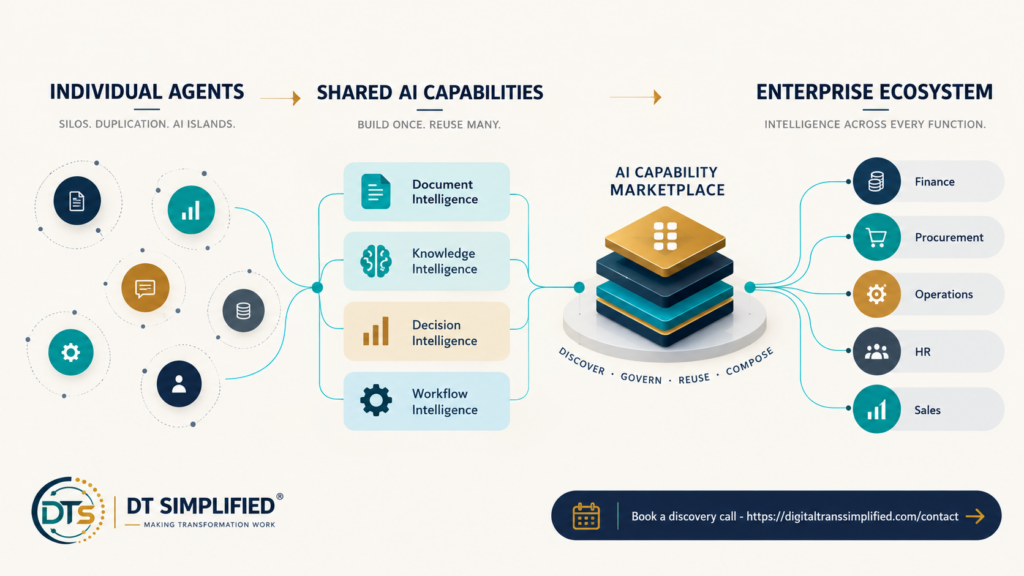
Agentic AI adoption can begin with individual business problems, but enterprise-scale value requires something more.
As organizations deploy agents across finance, procurement, operations, HR, sales, customer service and technology, a new challenge emerges: how do you prevent every function from building the same capabilities independently?
An agent created for document analysis in one business unit may have applications elsewhere. A supplier-risk capability developed for procurement may also support finance or operations. A knowledge agent created for one domain may become useful across the enterprise.
This is where the Marketplace-Driven Agentic Operating Model becomes relevant.
Rather than treating every Agentic AI capability as a one-off implementation, this model focuses on reusability, composability and enterprise-wide consumption of AI capabilities.
Its defining principle is:
Build reusable AI capabilities once, govern them centrally, and make them discoverable and consumable across the enterprise.
The model therefore shifts the focus from deploying individual agents to creating an ecosystem of reusable intelligent capabilities.
Why a Marketplace-Driven Model?
The economics of Agentic AI change significantly as adoption increases.
In the early stages, organizations may have a handful of use cases. Individual teams can experiment, select their own tools and build agents around specific requirements.
At scale, however, this approach can produce duplication.
Multiple business units may independently build document-intelligence capabilities. Different teams may create separate knowledge assistants. Several functions may develop similar workflow agents, each with its own integrations, security controls, monitoring and maintenance requirements.
The enterprise then has not created an AI ecosystem.
It has created a collection of AI islands.
The Marketplace-Driven model addresses this by treating Agentic AI capabilities as enterprise assets that can be packaged, governed, reused and consumed across business functions.
From Agents to Reusable Capabilities
The fundamental shift is from asking:
“What agent do we need for this process?”
to:
“What intelligent capability do we need, and where else can it be reused?”
A capability might include an agent, but it does not have to be limited to an autonomous agent.
It could be:
An AI agent
A specialized model
A document-intelligence capability
A knowledge service
A workflow component
A decision-support capability
A data or analytics service
An integration capability
A reusable business skill
A governed AI service
These components can then be combined into different business processes.
For example, a Contract Intelligence capability could support procurement contract review, legal operations, supplier management and finance controls.
A Document Intelligence capability could process invoices, contracts, project documents, applications and other enterprise documents.
An Executive Intelligence capability could combine information from multiple enterprise systems to identify trends, exceptions and decision points.
The objective is therefore not simply to create more agents.
It is to create more value from the agents and capabilities the enterprise already has.
The Enterprise AI Marketplace
At the center of this model is the concept of an enterprise marketplace.
This does not necessarily mean a public marketplace or a traditional software store.
It is a governed environment where business teams can discover, evaluate, consume and potentially compose approved AI capabilities.
A capability in the marketplace should ideally have information such as:
What does it do?
Which processes can use it?
What data does it require?
What systems can it connect to?
What decisions can it make?
What level of human oversight is required?
Who owns it?
How is it monitored?
What does it cost to consume?
This creates transparency around AI capabilities while reducing the need for every business team to independently evaluate and implement the same technology.
Reusability Becomes an Architectural Principle
Traditional enterprise applications are often implemented around specific business processes.
Agentic AI creates an opportunity to think differently.
Instead of embedding every intelligent capability directly into one workflow, organizations can create composable AI services that can participate in multiple workflows.
Consider a supplier-risk capability.
In procurement, it may evaluate suppliers during sourcing.
In finance, it may contribute to credit and payment-risk assessment.
In operations, it may identify supply-chain vulnerabilities.
In executive reporting, it may contribute to enterprise risk intelligence.
The underlying capability can remain common while the surrounding workflow changes according to the business context.
This is where the Marketplace-Driven model can generate significant leverage.
One capability can support many processes.
Governance Does Not Disappear
A marketplace model can easily become problematic if every team is allowed to publish and consume AI capabilities without controls.
The objective is therefore not an open AI marketplace with unlimited freedom.
It is a governed enterprise marketplace.
Enterprise standards should define the conditions under which capabilities can be introduced and consumed.
These can include:
Security and access controls
Data classification and permitted data usage
Model and agent approval
Responsible AI requirements
Performance standards
Auditability
Human oversight
Integration standards
Monitoring and observability
Version management
Cost and consumption controls
Retirement and lifecycle management
This becomes especially important when one AI capability is consumed by multiple business domains.
A change to a shared capability can potentially affect many downstream processes.
Therefore, reusability increases the importance of lifecycle governance.
Ownership in a Marketplace-Driven Model
The operating model also changes the question of ownership.
A business function may own the business outcome for a particular use case.
But a reusable AI capability may have an enterprise-level owner responsible for its lifecycle.
For example:
Business Domain
Defines the business requirement, process context and expected outcome.
Capability Owner
Maintains the reusable AI capability, its performance and lifecycle.
Enterprise Architecture
Ensures that the capability fits within enterprise architecture and integration standards.
AI Governance
Defines the controls under which the capability can operate.
Platform / Infrastructure Teams
Provide the technical environment required to operate and scale the capability.
This creates a model where AI becomes increasingly similar to other enterprise shared capabilities: owned, governed and reused rather than repeatedly recreated.
Alignment with the IT Operating Model
The Marketplace-Driven model is particularly compatible with operating models that can provide centralized governance and shared capabilities.
Centralized IT
Highly suitable.
Centralized IT can establish the marketplace, common architecture, security standards, AI governance and shared infrastructure.
Business teams consume approved capabilities rather than independently building foundational AI services.
IT Shared Services
Highly suitable.
This model naturally fits a shared-services structure.
AI capabilities can be offered as enterprise services that business units consume based on defined requirements and service standards.
Federated IT
Suitable with strong governance.
Domains can develop capabilities relevant to their own business areas and make suitable capabilities available through the enterprise marketplace.
The challenge is preventing every domain from creating duplicate capabilities.
Decentralized / Business-Led IT
Possible, but requires stronger marketplace controls.
Business-led innovation can generate useful AI capabilities quickly, but without common standards, the marketplace can become fragmented and difficult to govern.
Build, Buy or Rent
The Marketplace-Driven model also changes how organizations think about Build, Buy and Rent.
Not every capability needs to be built internally.
Build
The enterprise develops reusable capabilities itself when the capability is strategically important, highly differentiated or requires significant control.
The organization owns the architecture, lifecycle, integration and governance.
This can create strong long-term control but requires sustained engineering and platform capabilities.
Buy
The organization acquires commercially available AI capabilities and makes them available through its enterprise ecosystem.
This can accelerate adoption where mature capabilities already exist in the market.
The enterprise still needs to control how those capabilities are approved, integrated, governed and consumed.
Rent
AI capabilities can also be consumed as managed services.
This reduces upfront investment and allows organizations to onboard capabilities rapidly.
However, the enterprise has less control over the underlying infrastructure and economics, and consumption-based costs can increase as adoption scales. The underlying framework specifically associates Rent with rapid onboarding and lower upfront barriers, while noting the corresponding provider dependence and variable operating costs.
The important point is that Build, Buy and Rent can coexist within the marketplace.
The marketplace becomes the governed consumption layer, regardless of where the underlying capability originates.
From Procurement of Technology to Consumption of Capabilities
This also changes enterprise technology procurement.
In a traditional environment, a business unit may purchase an application to solve a particular problem.
In a Marketplace-Driven Agentic environment, the enterprise can increasingly ask:
Do we already have an approved capability that can solve this problem?
If yes, the organization consumes and configures it.
If not, it evaluates whether a new capability should be built, bought or rented.
This creates an important economic benefit.
Instead of repeatedly funding similar AI implementations, the enterprise can invest in shared capabilities and then distribute their value across multiple processes and functions.
The Marketplace as an AI Scaling Mechanism
The real value of this operating model therefore comes from the relationship between reuse and scale.
Imagine an organization develops five reusable AI capabilities:
Document Intelligence
→ invoices, contracts, applications, project documents
Knowledge Intelligence
→ policies, procedures, enterprise knowledge
Decision Intelligence
→ analysis, recommendations and business decisions
Workflow Intelligence
→ multi-step process coordination
Executive Intelligence
→ trends, exceptions, alerts and decision support
These capabilities can then participate in dozens of business processes.
The enterprise does not need to create a completely new AI architecture for every process.
Instead, it can compose existing capabilities into new business solutions.
This is the foundation of an enterprise AI ecosystem.
The Risk: The Marketplace Can Become Another Technology Silo
There is an important paradox.
A marketplace is intended to reduce fragmentation.
But if it becomes merely a catalogue of AI tools, it can create another layer of complexity.
A successful Marketplace-Driven model therefore needs more than a technology catalogue.
It requires:
Discovery + Governance + Ownership + Integration + Observability + Economics + Lifecycle Management
A capability should not simply be available.
It should be trusted, measurable, maintainable and reusable.
That distinction separates an enterprise AI marketplace from a collection of AI tools.
When Does Marketplace-Driven Make Sense?
The model becomes particularly valuable when:
Multiple business functions have similar AI requirements.
The enterprise wants to reuse AI investments.
AI adoption is moving beyond individual experiments.
Shared services and common capabilities can create economies of scale.
Business units need faster access to approved AI capabilities.
The organization has strong enterprise governance.
There is a growing portfolio of agents, AI services and automation capabilities.
The enterprise wants to reduce duplicated AI development.
It becomes less effective when the organization is still at a very early experimentation stage or when business processes are so specialized that meaningful reuse is limited.
Marketplace-Driven vs. Federated Domain
The distinction between the fourth and fifth models is particularly important.
Federated Domain asks:
How can individual domains innovate autonomously while remaining within enterprise standards?
Marketplace-Driven asks:
How can the enterprise turn those AI capabilities into reusable assets that can be consumed across domains?
The two models can therefore complement each other.
A domain may develop a capability under a Federated Domain structure.
Once that capability proves valuable beyond the original domain, it can potentially become an enterprise marketplace asset.
This creates a natural progression:
Domain Innovation → Capability Validation → Capability Standardization → Enterprise Reuse → Scale
The Strategic Shift
The Marketplace-Driven model represents another step in the evolution of Agentic AI.
The enterprise is no longer thinking only about individual agents.
It is beginning to think about an economy of reusable intelligence.
Agents, models, workflows, data capabilities and intelligent services become assets that can be reused across the organization.
This can change the economics of AI transformation.
Instead of:
One problem → One solution → One implementation
the enterprise can move toward:
One capability → Multiple applications → Enterprise-scale value
From Federated Intelligence to an Enterprise AI Ecosystem
Across the five operating models, the progression now becomes:
Enterprise Overlay
Add intelligence around existing systems.
Agentic Platform
Embed intelligence into enterprise execution.
SaaS-Native Agentic Reengineering
Redesign workflows around modern SaaS and embedded AI.
Federated Domain
Distribute AI ownership while maintaining enterprise governance.
Marketplace-Driven
Turn AI capabilities into reusable enterprise assets that can be consumed across domains.
The Marketplace-Driven model therefore addresses a critical scaling problem:
How does an enterprise move from building AI solutions to building an ecosystem of reusable intelligence?
The answer is not necessarily to centralize every AI capability.
It is to make valuable capabilities discoverable, governed, reusable and composable.
And once an enterprise reaches this stage, another reality becomes apparent: not every part of the organization will mature at the same pace.
Some domains will be centralized. Others will remain federated. Some will use embedded platforms, while others will continue with overlays or marketplace capabilities.
That brings us to the sixth model in the framework:
Hybrid Transitional — where multiple Agentic AI operating models coexist as the enterprise evolves.
Want more perspectives on digital transformation, data and AI?
Explore all insights →