In my earlier article, “How to Choose the Right Agentic AI Operating Model,” I introduced six ways enterprises can structure Agentic AI across their technology, processes, governance and operating models. The first three models represent different ways of changing the relationship between Agentic AI and the enterprise technology landscape:
Enterprise Overlay adds intelligence around existing systems.
Agentic Platform embeds Agentic AI into the execution architecture.
SaaS-Native Agentic Reengineering redesigns business workflows around modern SaaS and embedded AI.
The fourth model takes a different approach.
What happens when the enterprise does not want every business function to adopt Agentic AI in exactly the same way?
This is where the Federated Domain Agentic Operating Model becomes relevant.
What is the Federated Domain Agentic Operating Model?
Large enterprises rarely operate as a single homogeneous business.
Finance, procurement, sales, HR, engineering, operations and other functions often have different processes, data, regulatory requirements, technology environments and levels of digital maturity.
A single enterprise-wide Agentic AI architecture can therefore become too restrictive, while completely independent AI adoption can create disconnected intelligence islands.
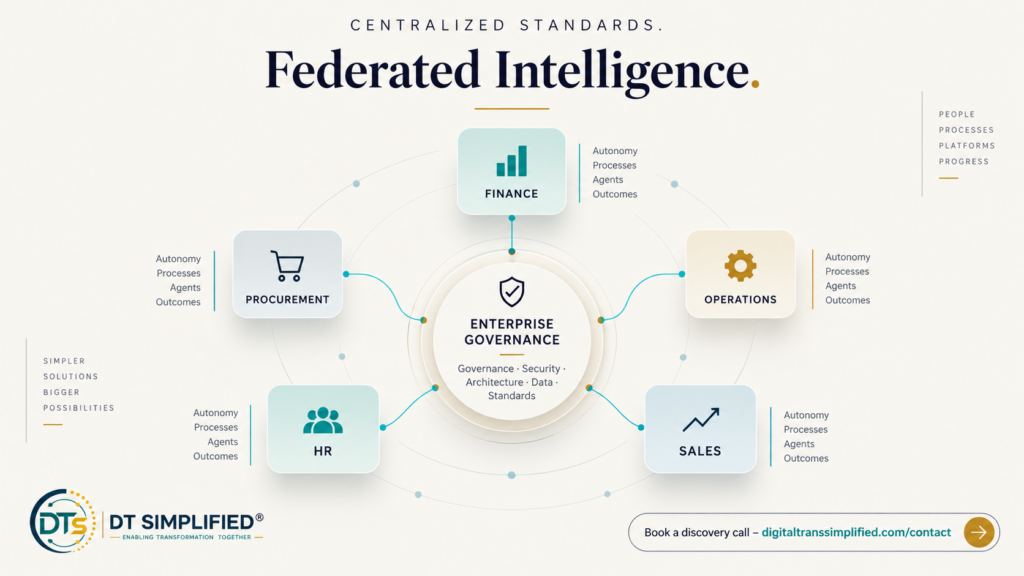
The Federated Domain Agentic Operating Model addresses this tension by giving individual business domains greater autonomy to design and operate their Agentic AI capabilities, while maintaining enterprise-wide standards for governance, security, architecture, data access, identity, auditability and responsible AI.
Its defining principle is:
Domain autonomy within enterprise standards and governance.
This means the enterprise does not necessarily mandate one common agent, one platform or one implementation approach. Instead, it establishes the boundaries within which domains can innovate.
A Finance domain may develop agents for financial analysis and controls. Procurement may deploy agents for sourcing, supplier evaluation and contract processes. HR may use agents for workforce services and employee operations.
The domain owns the business outcome and day-to-day operation of its AI capabilities, while enterprise governance establishes the rules under which those capabilities operate.
From Enterprise Control to Domain Accountability
The fundamental change in this model is not simply technological.
It is a change in where Agentic AI accountability sits.
In a centralized model, an enterprise technology or AI team may own most of the architecture, platforms and lifecycle. In a federated model, the business domain becomes much more directly responsible for how agents are designed, deployed and used.
This can make Agentic AI adoption faster because domain teams understand their own processes, exceptions and decision criteria better than a central team.
But autonomy does not mean independence.
A domain may determine how an agent supports its business process, but it should operate within enterprise-defined boundaries for identity, security, data access, model usage, human oversight, audit trails and risk management.
The result is a federated execution model with centralized guardrails.
Why Enterprises Consider This Model
The Federated Domain model becomes particularly relevant when different business functions have materially different needs.
For example, a financial-services organization may require significantly stronger controls around financial decisioning than an internal knowledge-management function. A manufacturing organization may need engineering agents operating close to plant operations, while its HR organization may have completely different requirements around employee data.
Trying to impose one identical Agentic AI implementation across both environments can slow adoption.
The federated approach allows each domain to move at an appropriate pace while still participating in the enterprise architecture.
It also recognizes an important reality of Agentic AI transformation:
AI maturity will not progress uniformly across an enterprise.
One domain may be ready for autonomous execution. Another may still be experimenting with decision support. A third may be constrained by legacy systems or regulatory requirements.
Federation allows these differences to exist without abandoning enterprise governance.
How the Model Works
The operating model can be thought of as two connected layers of responsibility.
Domain layer
The business domain owns:
Business use cases and outcomes
Process-specific agent design
Domain knowledge and policies
Workflow configuration
Human-agent interaction
Domain-level performance
Adoption and value realization
Enterprise layer
The enterprise establishes:
Architecture standards
Identity and access management
Security controls
Data governance
Responsible AI requirements
Model-risk controls
Auditability
Integration standards
Agent lifecycle standards
Enterprise interoperability
The boundary between the two is important.
The enterprise should govern what cannot be compromised.
The domain should have freedom over how business outcomes are achieved within those boundaries.
Agentic AI in a Federated Domain
The architecture therefore becomes less about one centralized agentic brain and more about a network of governed domain capabilities.
For example:
Finance
Agents can support financial analysis, forecasting, reconciliations, controls and exception handling.
Procurement
Agents can support sourcing, supplier analysis, negotiations, contract interpretation and procurement operations.
Operations
Agents can monitor operational conditions, identify exceptions, coordinate responses and support operational decisions.
HR
Agents can support employee services, workforce processes, policy interpretation and administrative workflows.
These agents do not necessarily need to be built on exactly the same technology.
What matters is that they can operate within common enterprise boundaries and, where required, exchange information and coordinate across domains.
That creates an important distinction from isolated departmental AI.
Federation is not decentralization without control.
It is controlled autonomy.
The Role of the Enterprise AI Governance Layer
The central enterprise function therefore changes.
Instead of attempting to build and operate every agent, it increasingly becomes the governor and enabler of the federated ecosystem.
It establishes common policies and reusable standards so that domains do not have to independently solve the same foundational problems.
For example, a domain may choose its own agent for a specific business capability, but the enterprise can still require:
approved identity mechanisms
approved data access patterns
security and privacy controls
model-risk assessment
logging and auditability
human approval for defined classes of decisions
monitoring of agent performance
defined escalation mechanisms
controls for autonomous actions
This allows innovation to move closer to the business without allowing enterprise risk management to fragment.
Alignment with the IT Operating Model
The Federated Domain model has a natural relationship with a Federated IT Operating Model.
Business domains already have technology ownership, architecture capabilities and decision rights. Agentic AI can therefore be incorporated into those existing structures rather than creating an entirely new centralized organization.
However, the model can also work with other IT configurations.
Centralized IT
Moderately suitable.
Centralized IT can provide the enterprise architecture, security, AI governance and shared infrastructure, while allowing designated domains controlled autonomy.
The challenge is avoiding excessive central approval that undermines the purpose of federation.
IT Shared Services
Suitable.
Shared services can provide common capabilities such as identity, integration, data services, AI infrastructure and governance tooling, while domains own their business-specific agents and processes.
Federated IT
Highly suitable.
This is the natural fit. Domain technology teams can own Agentic AI capabilities while enterprise architecture establishes common standards and governance.
Decentralized / Business-Led IT
Potentially suitable, but governance becomes critical.
The model can accelerate innovation, but without common standards it can quickly produce duplicated agents, inconsistent data practices, fragmented technology choices and uncontrolled AI risk.
Build, Buy or Rent?
One of the interesting characteristics of the Federated Domain model is that the enterprise does not necessarily need one implementation strategy for every domain.
This is fundamentally different from a centralized platform strategy.
One domain may Build because it has highly differentiated processes and sufficient technical capability.
Another may Buy because a mature commercial Agentic AI capability already exists for its requirements.
A third may Rent capabilities from an external provider because its objective is experimentation or rapid adoption.
The enterprise operating model remains federated even though the implementation choices differ by domain.
This creates a portfolio approach to Agentic AI investment:
Domain need → appropriate implementation strategy → enterprise governance.
The enterprise therefore governs the boundaries and interoperability rather than forcing technological uniformity.
Where the Federated Domain Model Works Best
This model is particularly relevant where:
Business functions have significant autonomy.
Domains have materially different processes or regulatory requirements.
Local business knowledge is important to AI effectiveness.
Different domains are at different levels of AI maturity.
Business units already have technology ownership.
The enterprise wants to accelerate AI adoption without creating uncontrolled fragmentation.
There is a strong need for domain-specific AI capabilities.
It is less effective when the enterprise lacks basic governance, architecture standards or clear business ownership.
Without those foundations, federation can simply become AI fragmentation.
The Governance Challenge
The biggest risk in this model is not whether domains can build agents.
It is whether those agents can coexist safely.
If every domain independently selects models, vendors, data sources, agent frameworks and autonomy policies, the enterprise can end up with multiple versions of the same capability, incompatible architectures and inconsistent controls.
Therefore, the federated model requires a clear distinction between domain freedom and enterprise non-negotiables.
The enterprise should standardize the foundations while allowing domains to differentiate where business value requires it.
That includes common principles for:
Identity → Security → Data → Architecture → Governance → Audit → Risk → Interoperability
while leaving room for domain-specific:
Processes → Agents → Workflows → Business Rules → Decision Logic → User Experience
Federated Domain vs. the First Three Models
The difference becomes clearer when the four models are viewed together.
| Operating Model | Primary Change |
|---|---|
| Enterprise Overlay | Add intelligence and orchestration around existing systems |
| Agentic Platform | Embed Agentic AI into enterprise execution architecture |
| SaaS-Native Agentic Reengineering | Redesign workflows around modern SaaS and embedded AI |
| Federated Domain | Give domains autonomy to develop Agentic AI within enterprise governance |
The first three primarily describe how Agentic AI changes the relationship with enterprise technology and processes.
The Federated Domain model adds another dimension:
Who owns the intelligence and decision-making capability?
That makes it particularly relevant to large, complex enterprises where organizational structure matters as much as technology architecture.
The Strategic Trade-off
The Federated Domain model does not attempt to eliminate variation.
It attempts to make variation governable.
Its advantage is speed, business ownership and domain relevance.
Its risk is fragmentation.
The success of the model therefore depends on getting the boundary right:
Centralize the standards. Federate the intelligence.
When that boundary is well designed, individual domains can innovate without creating independent AI ecosystems that the enterprise later has to reconcile.
From Enterprise Intelligence to Federated Intelligence
The progression across the first four operating models now becomes clearer:
Enterprise Overlay → add intelligence around what exists.
Agentic Platform → embed intelligence into execution.
SaaS-Native Agentic Reengineering → redesign execution around intelligence.
Federated Domain → distribute intelligence ownership while maintaining enterprise control.
The question is no longer simply where Agentic AI sits in the technology stack.
It becomes:
Where should intelligence reside, who should control it, and what must remain common across the enterprise?
For organizations with strong business-domain autonomy, the answer may not be one enterprise-wide Agentic AI architecture.
It may be a federated ecosystem of intelligent domains operating within a common enterprise framework.
And that leads naturally to the next question in the operating-model journey:
Once domains begin creating agents independently, how does the enterprise make those capabilities reusable across the organization?
That is where the Marketplace-Driven Agentic Operating Model becomes relevant.
Want more perspectives on digital transformation, data and AI?
Explore all insights →